
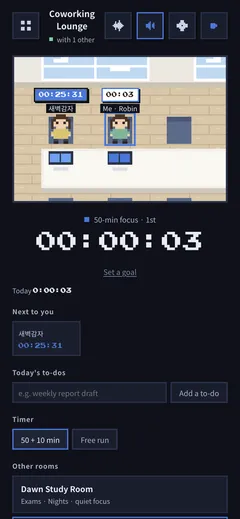
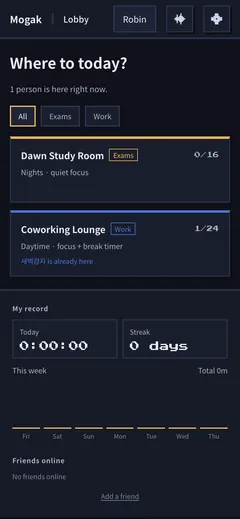
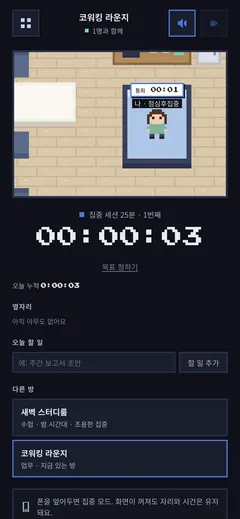
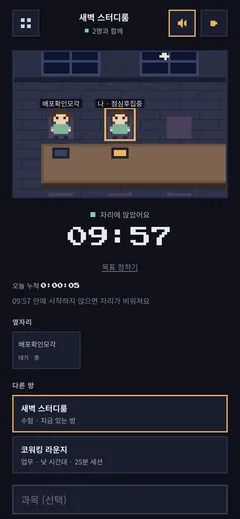
Mogak (모각, short for “모여서 각자”, together but each on our own) shows the motivation of “others are at it right now” through a shared space and characters rather than numbers. With no signup, you pick a nickname and an avatar and choose a room in the lobby and take an empty seat. Your state (focusing, on a break, about to come back) and your time appear on the name tag above your head. The interface is available in Korean, Japanese and English.
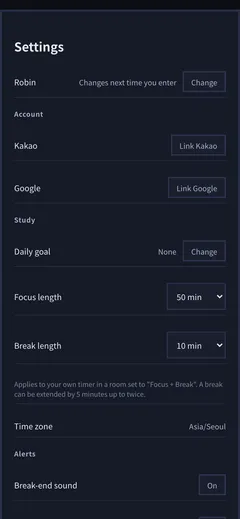
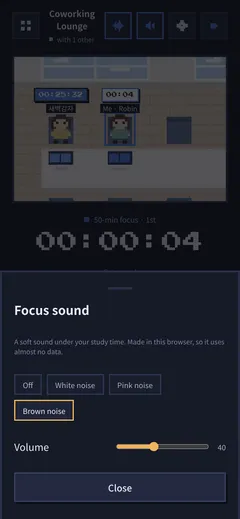
The screens above were taken on the live site. The first four show version 1.0; the call booth and the room move are from before it (November 4) and show the Korean interface. The other guests are the operator and test accounts, so the rooms look empty.
What it does
- Two rooms, picked from a lobby — a late-night study room (exams, 16 seats, a sofa) and a daytime coworking lounge (work, 24 seats, a coffee bar, a call booth). In the lounge you can jot down today’s to-dos. The lobby shows how many people are in each room and your record for the week, and returning guests get a card that takes them back to their last seat
- Sit down to start — take a seat to start studying. Both rooms let you choose between a focus / break timer (25 or 50 minutes of focus, 5, 10 or 15 minutes of break) and Free run; the lounge starts on the timer. You take breaks on the sofa (at the coffee bar in the lounge); a Free run break is 5 minutes, and any break can be extended by 5 minutes up to twice. At 4 hours it asks whether to keep going, and when a break ends it tells you with an on-screen notice and a sound
- Cheers instead of words — send people in the same room a coffee, a “you got this” or another set cheer, optionally with one of a few set lines (with a daily limit). A speech bubble appears beside their head for 10 seconds
- Records only you see — today’s goal, subject (visible only to you), daily total and attendance streak. The day turns over at 4 am. Connect Kakao or Google to keep your records on other devices too
- Focus sounds — white, pink and brown noise generated in the browser, with no audio files
- Your seat on a phone, the whole room on a wide screen — add it to the home screen (PWA) and use it like an app
- Friends — send a friend link; once the other person accepts, you are friends and see “friend online” in the lobby
- Block and report nicknames, and “Delete all records” in Settings
Judgment calls
Time is counted on the server clock only. Turn a phone face down and the page freezes; timers in hidden tabs slow to once a minute. So the screen draws from the start time the server sent, and connection checks use protocol-level pings that the browser answers on its own. If the connection drops, your seat and session stay, shown as “face down”.
With no signup, a guest is one cookie. A single HttpOnly cookie identifies each guest, and it is bound to the server’s address. So when the service moved to the mogak address, the server address stayed as it was; changing it would have cost every guest their records.
The server and database share one 1 GB box in Seoul. That is a cost decision. To keep AWS keys off the box, backups are seven daily dumps plus Lightsail snapshots. Running costs are about $9–10 a month.
There is no chat. Free text brings reporting and moderation with it. So there are only set cheers and set lines, and the banned-word check runs on nicknames alone.